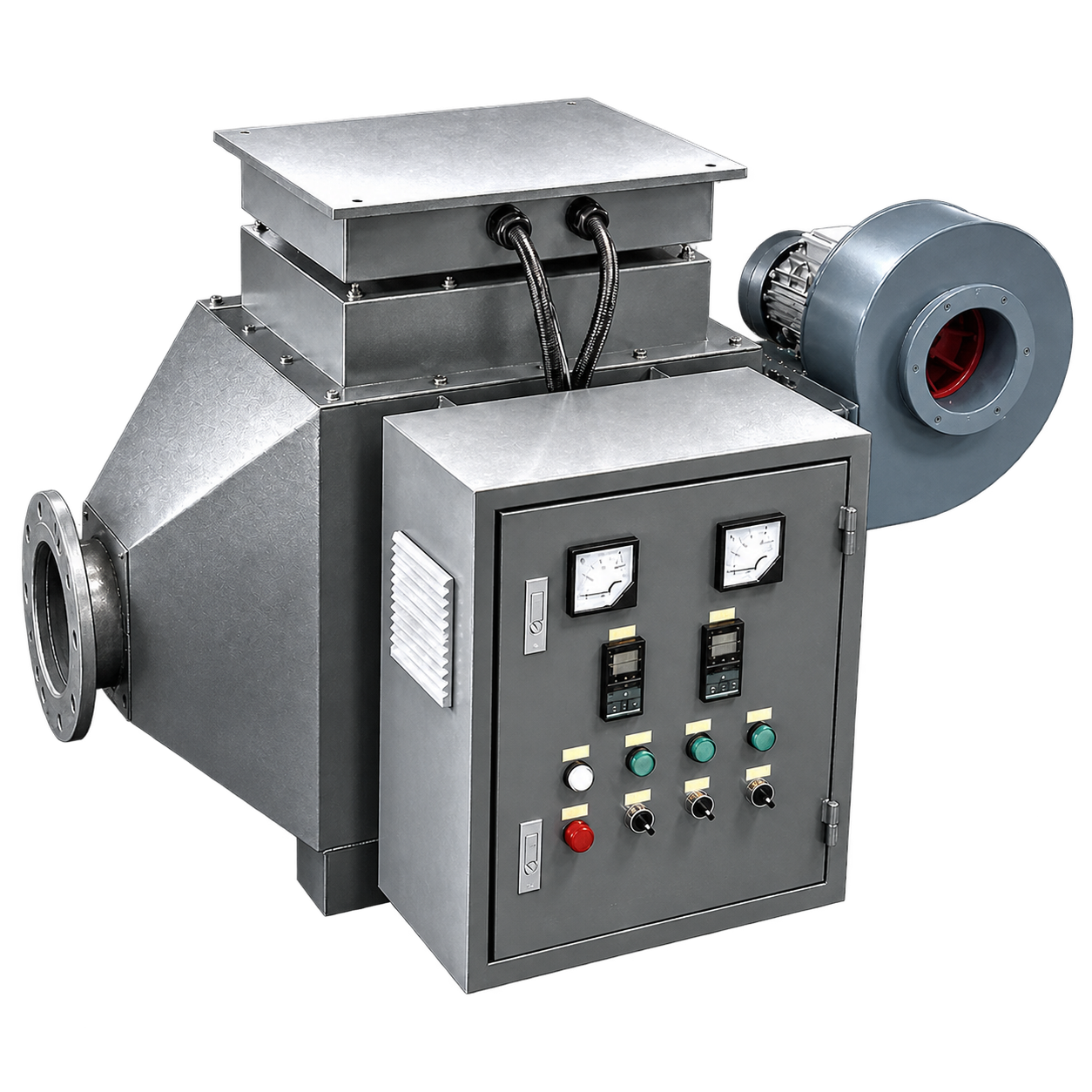
Temperature uniformity
A wide spread inside the room dries unevenly, so hot-air outlets and guiding structures must be laid out to avoid local overheating.
 DIANREZHANELECTRIC HEATINGIndustry Solutions中文
INDUSTRY SOLUTION · S3
Stable hot air for drying rooms, lines and fresh-air systems. Judge velocity, temperature uniformity and staged control.
SCENARIO
Drying rooms and lines in food, timber, plating, foundry and chemical-raw-material work heat circulating air or fresh make-up air to process temperature and hold it there. Drying quality depends on hot-air uniformity and circulation efficiency: too hot damages the product, too cool slows the cycle.
A wide spread inside the room dries unevenly, so hot-air outlets and guiding structures must be laid out to avoid local overheating.
Driving out moisture means admitting fresh air, and that load materially raises total power, so it must be sized against the cycle time.
Drying is usually a continuous process, so the heating needs staged redundancy and fault alarms to avoid line stoppage.
Different products need different temperature windows, which normally calls for continuous PID control rather than simple on/off.
SOLUTION PATH
Total power from circulating volume, fresh-air volume, temperature rise and room heat loss, splitting the duty between initial heat-up and holding.
Pick a duct heater or a fan-and-heater unit according to duct or room structure, and set fin density and flow-plate arrangement.
Switch groups along the load curve and hold temperature with PID or SSR power control; multi-zone rooms can be controlled zone by zone.
Provide over-temperature protection and fan interlock, leave pull-out clearance for the heated section, and clean dust from the fins on a schedule.
RECOMMENDED EQUIPMENT
FAQ
Usually three things: add a flow-straightening plate at the heater outlet, reposition the return-air opening, and match the circulation fan volume. Independent multi-zone control where needed.
Mostly not. Temperature-window differences are handled in the control system. But if the product carries solvent or dust, explosion protection and residue build-up have to be confirmed.
Both automatic and manual restart can be configured. Where flammable media are present, manual reset is recommended so the unit cannot start unattended.
INQUIRY PREP