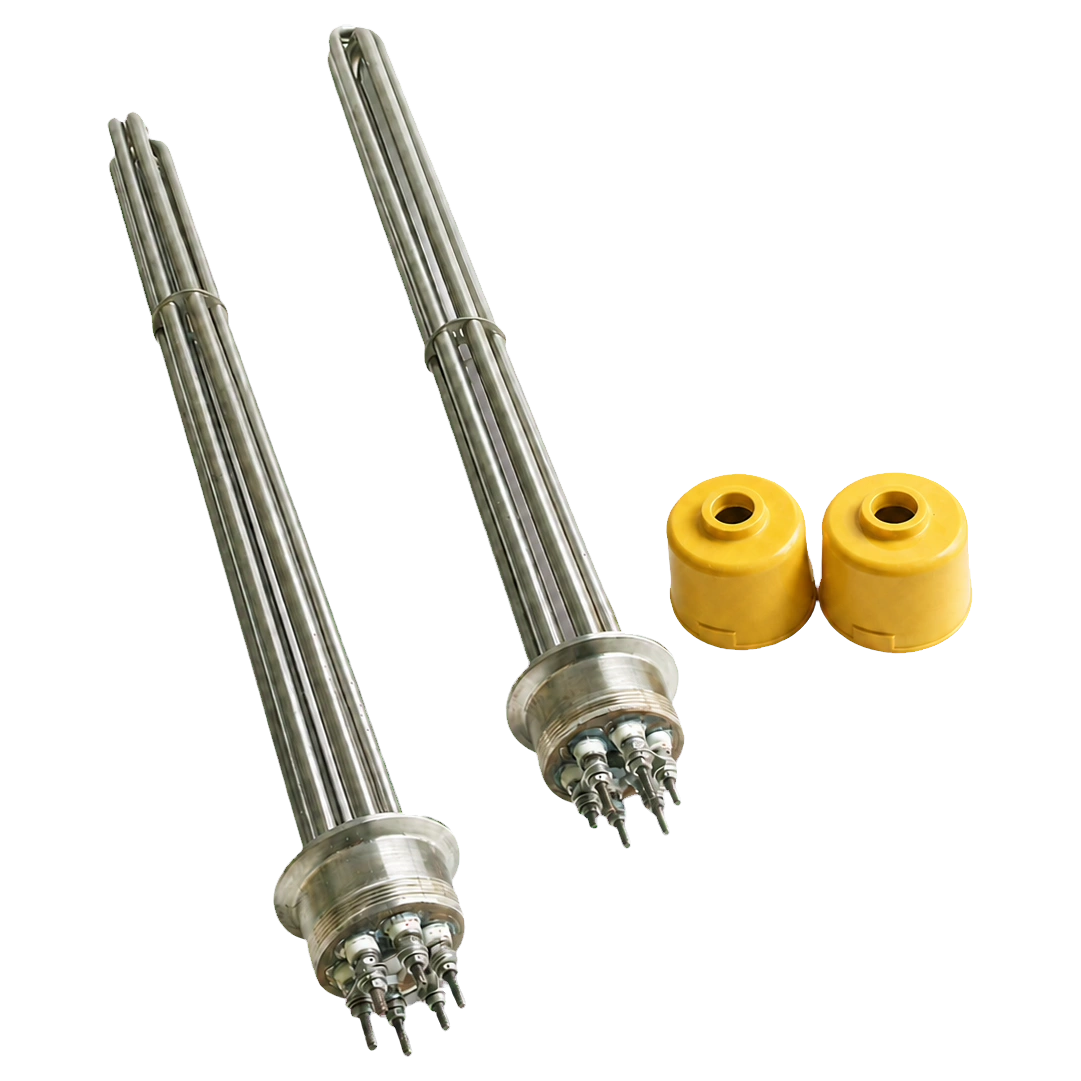
Scaling and deposits
Hard water and process residue scale onto the element, cutting heat transfer and causing local overheating, so surface load must be limited and cleaning left accessible.
 DIANREZHANELECTRIC HEATINGIndustry Solutions中文
INDUSTRY SOLUTION · S5
Liquid heat-up through flanged immersion elements or an external loop. Watch level, scaling, material and surface load.
SCENARIO
Plating pre-treatment, machine washing, food processing and chemical storage all need the liquid in a tank or vessel heated and held. Water-based liquids scale, oils and chemicals attack materials, and falling level brings dry-fire risk — together these decide element construction and material.
Hard water and process residue scale onto the element, cutting heat transfer and causing local overheating, so surface load must be limited and cleaning left accessible.
When draining or evaporation drops the level, uncovered elements overheat and fail, so level protection is mandatory.
Acids, alkalis, salts and chlorides attack stainless steel; sheath material — 316L, titanium, PTFE — is chosen against the medium.
A single point in a large tank stratifies; elements must be distributed or combined with circulation and agitation.
SOLUTION PATH
Establish liquid type, volume, target temperature and heat-up time, then calculate heat-up power and holding power.
Select flanged, threaded or external circulation heating according to tank structure, and fix element position and spacing.
Pick the sheath material from corrosivity and scaling tendency, limit surface watt density, and leave clearance for cleaning and replacement in scaling duty.
Low-level cut-out, over-temperature protection and a temperature controller, with a circulation pump where uniformity needs help.
RECOMMENDED EQUIPMENT
FAQ
Limiting surface load is the root fix: choose low watt-density elements in scaling duty and descale on a schedule. Where water quality is very poor, external circulation heating keeps the elements out of the bath.
Sheath material follows concentration and temperature — commonly 316L, titanium or PTFE covering. For strongly corrosive media, send the full medium analysis before confirmation.
It can. A level switch or electrode level gauge interlocks into the control cabinet, cutting heating and alarming below the set level to prevent dry firing.
INQUIRY PREP